

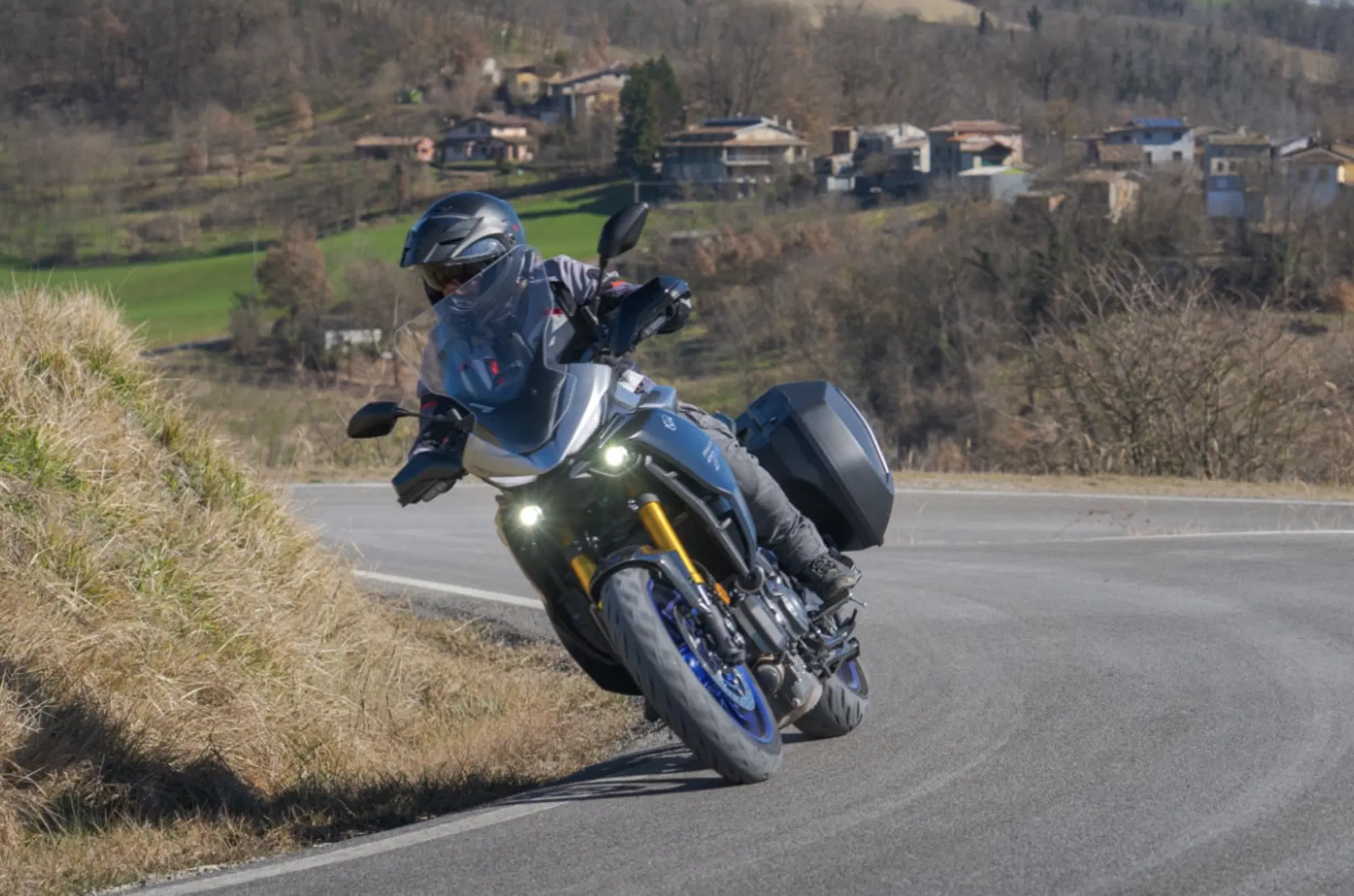

Yamaha Tracer 7 and Tracer 9: versatile tourer

Can the Tracer 7 really handle two-up touring with luggage? And does the technologically advanced Tracer 9 make sense in everyday city traffic?
We tend to categorize motorcycles according to their intended purpose: sport bikes for carving through corners, touring motorcycles for covering long distances, and adventure bikes for exploring beyond the asphalt. But are these distinctions always justified? Moto.it's Pietro and Lillo decided to challenge these assumptions, using two very different Yamaha motorcycles as examples: the Tracer 7 and Tracer 9.
The first question concerns the Tracer 7 and its 73.5 hp CP2 twin-cylinder engine. Is that enough power for traveling with a passenger and luggage?
The answer is that horsepower figures rarely tell the whole story. Strong midrange torque, smooth power delivery and a well-balanced chassis allow Yamaha's middleweight sport tourer to handle long-distance journeys with confidence.
The GT version offers additional touring equipment, while features such as ride-by-wire throttle and cruise control make the latest Tracer 7 increasingly sophisticated.
And compared with larger touring motorcycles, it offers another important advantage: more manageable weight and dimensions, particularly when maneuvering a fully loaded bike at low speed or while stationary.
At the other end of the range is the Tracer 9, a sport-touring motorcycle combining long-distance comfort with engaging performance, thanks largely to its characterful CP3 three-cylinder engine.
But what makes the Tracer 9 particularly interesting is how its advanced electronics can improve everyday riding.
Semi-active suspension, radar-based rider assistance, blind spot monitoring and, on higher-spec versions, Matrix LED headlights are technologies that can prove useful not only on long journeys but also in heavy traffic and during nighttime riding.
The real difference isn't simply the number of electronic features included on a motorcycle. It's how effectively they work together without becoming intrusive or distracting.
The discussion also explores Yamaha's Y-AMT automated transmission, which can make city riding significantly easier without compromising riding enjoyment.
During a previous test in Milan, Pietro counted more than one hundred clutch and gearshift operations on a conventional MT-09 during a relatively short urban journey. With Y-AMT, those operations can be handled automatically.
But could this technology eventually make its way onto Yamaha's sport bikes? According to our testers, a system like Y-AMT could offer interesting advantages on motorcycles such as the R9 or R1, allowing riders to focus more on braking, cornering and choosing the right racing lines.
The conclusion is straightforward: a motorcycle doesn't have to be restricted to the type of riding it was originally designed for. The Tracer 7 can be a capable long-distance tourer, while the Tracer 9 can make even everyday commuting easier and more enjoyable.
Because sometimes, the true versatility of a motorcycle only becomes clear once you ride it.