

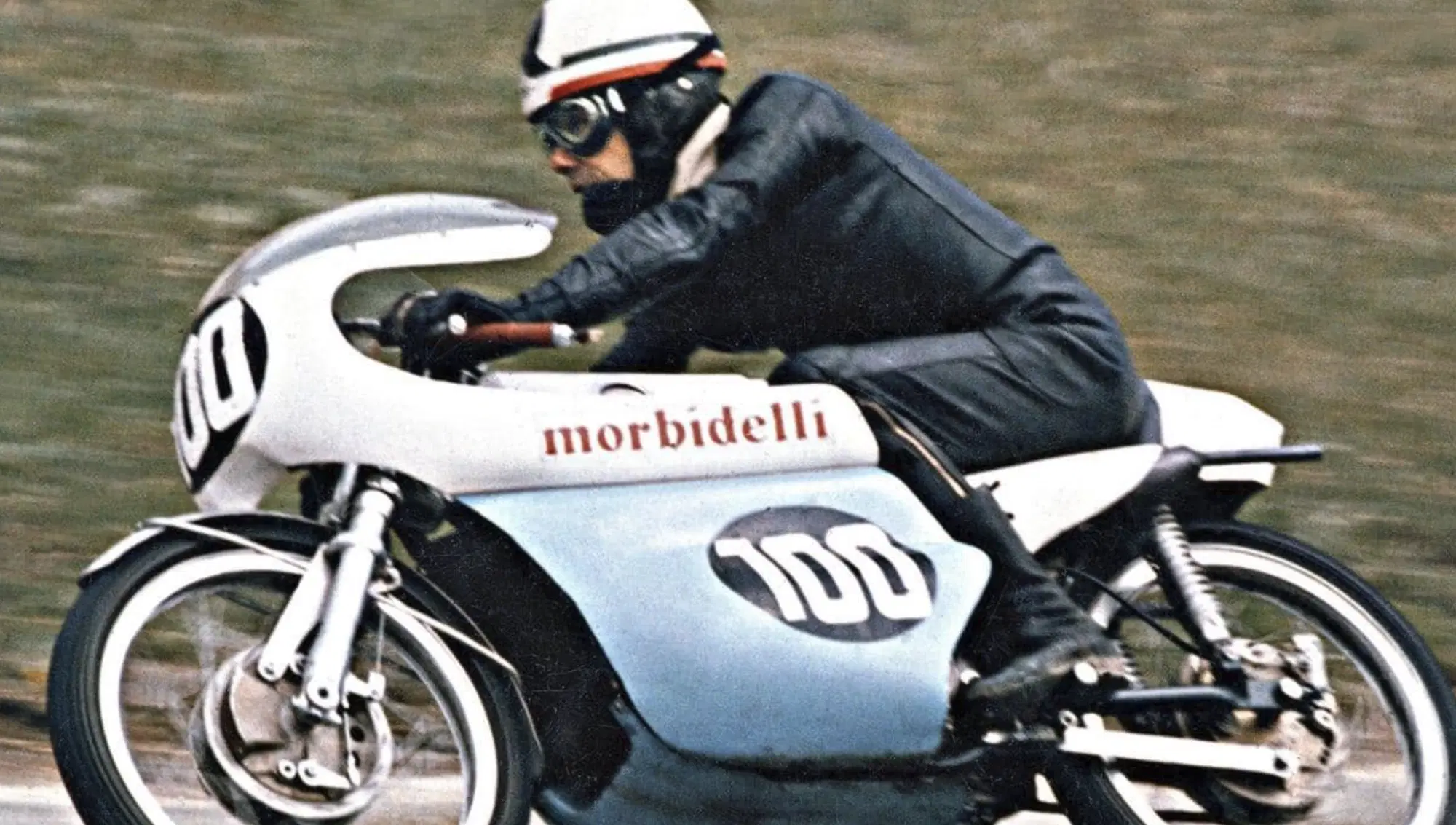

Gilberto Parlotti: A Neorealist Film Face, Golden Hands, and a Broken Dream at the TT
From the Trieste workshop to the summit of the 125 World Championship with Morbidelli
There was an era when becoming a world champion didn't require data telemetry, futuristic gyms, or five-star motorhomes. It required grease-stained hands, an extraordinary ear capable of hearing the engine long before reading the tachometer, and a visceral passion—the kind only breathed amid two-stroke exhaust fumes and flying gravel. Gilberto Parlotti was the quintessential emblem of that pioneering, romantic brand of motorcycle racing.
To look at him, he seemed straight out of an Italian Neorealist film: a proud face etched with hard work and fatigue, a weathered leather suit, and an ever-present cigarette between his lips. While his close friend Giacomo Agostini embodied the handsome, untouchable movie star made for glossy magazine covers, Parlotti was the guy next door: the mechanic you immediately wanted to stop in the paddock just to ask how the engine was running.
Born in Zero Branco in 1940 and raised in Trieste, Gilberto grew up on a diet of wrenches and connecting rods. In the family workshop, alongside his father Angelo and brothers Gino and Silvano, they repaired anything on wheels. Yet true, raw racing talent erupted on the open roads: first blowing past rivals aboard a Motom 50, then clinching the national gymkhana championship in 1960, and cutting his teeth in grueling hillclimbs with a Morini 125.
Parlotti could ride anything fast, but in the small-displacement classes, he was pure magic. In the 1960s, he linked his career to Tomos, the Yugoslav manufacturer based in Koper (Capodistria)—just 22 kilometers from his front door—which produced ingenious feats of engineering: the legendary nine-speed D9 tipped the scales at a mere 38 kilograms. Aboard the Tomos, he claimed Italian championships and became the undisputed master of the blisteringly fast, treacherous coastal track at Opatija (Abbazia). Right there, in 1969, he wrote a memorable chapter of sportsmanship: called up by Benelli to back up Kel Carruthers in the title-deciding 250cc showdown, Gilberto—who was practically unbeatable on that circuit—strictly followed team orders, set the fastest lap, and shadowed his teammate across the line, securing Carruthers the crown in what proved to be the final Grand Prix victory for a 250cc four-stroke.
The turning point came in 1970 when Giancarlo Morbidelli recruited him to Pesaro, handing him the development of the new twin-cylinder 125. Meanwhile, Parlotti struck out on his own in Trieste, opening his shop, Racing Store, while overcoming the bike's early teething troubles to claim historic victories at Brno and Monza.
By the dawn of 1972, the Morbidelli had matured into an unstoppable rocket. Parlotti kicked off the season dominating at the Nürburgring and Clermont-Ferrand—where Yamaha even lodged a formal protest, baffled that such a missile could possibly be a legal 125—before taking podiums at Salzburgring and Imola. He sat firmly atop the world championship standings, well clear of Chas Mortimer and Ángel Nieto. The lifelong dream of a world title was within his grasp.
Next up was the Tourist Trophy. Even back then, riders were turning against it: the Mountain Course was a maze of stone walls and telegraph poles where the slightest slip cost a life. Nieto chose to stay home. But Gilberto refused to leave anything to chance; he wanted that crown. He reached the Isle of Man ten days early, scoping out every bend first in a rental car and then aboard a Ducati 900 he had shipped over. The night before race day, he did one final reconnaissance lap alongside Agostini, who kept drilling into him the golden rule of the TT: "It's not about knowing where to open the throttle, but where to roll off."
On June 9, 1972, spring suddenly gave way to a bleak nightmare of driving rain, fog, and freezing tarmac. Parlotti launched off the line: after just one lap, he held a commanding 15-second lead over Mortimer. But up on the mountain section at the Verandah bend, amid zero visibility and treacherous yellow lines painted on the slick asphalt, the Morbidelli broke away like a wet bar of soap. The high-speed impact with a roadside obstacle proved fatal, cutting his life short at just 31 years old.
Racing, as was the grim custom of the era, carried on. Agostini won the 500cc race a few hours later with a shattered heart, but immediately afterward vowed never to race the Mountain Course again. Ago spearheaded the riders' boycott, which within four years compelled the FIM to strip the TT of its Grand Prix world championship status.
Decades later, the memory of Gilberto Parlotti still soars high, just like the Karst peregrine falcon painted on his helmet—an unforgettable symbol of genuine passion, modesty, and old-school grit.